

Who is behind an online cash offer site?
Some online cash offer sites in Arizona buy the house themselves; the rest pass your address to whoever pays for it, and the agreement is where you find out which.
Every online cash offer site is one of three machines. A principal buyer pays for your house with its own money. A lead-routing marketplace passes your address to a network of agents or investors. A review layer ranks the other two and earns a fee when you click through. One question settles which one you are typing into: who signs as the buyer on the agreement, and can that name change afterward? This page reads the major companies’ own pages and the federal record for you, dated, and prints our own answers under the same questions.
Call Stephen W. Rockwell and his team at (480) 444-2274 and ask him which machine a site is; he will tell you in a minute.
We Buy Houses Arizona™ has bought more than 2,000 houses in the Phoenix metro, East Valley, and Pinal County since 1999. Stephen W. Rockwell founded the company in Mesa, where it still operates from 7726 E. Baseline Rd., Unit 203, and it has held BBB A+ accreditation since April 17, 2019. We are the first machine, and we wrote this page because sellers call us after typing their address into one of the other two. Nothing here asks you to trust us; every claim about another company is that company’s own published sentence, dated and linked.
We Buy Houses Arizona is independent, not part of any national network or franchise.

The three machines behind every cash offer website
Three machines sit behind every cash offer website: the principal buyer, the lead-routing marketplace, and the review layer. The names on the sites change every year; the machines do not. Once you know the three, you can sort a site you have never heard of in the time it takes to read its first screen.

Principal Buyer
The company on the site buys the house itself, with its own money, and its name goes on the agreement as the buyer. A local direct buyer is a principal buyer. So is an iBuyer, the large, publicly traded version that prices houses from data and buys at scale. The two differ in how the number is built and what it costs you; they agree on who is buying.
Lead-Routing Marketplace
The site is not the buyer. Your address becomes a lead and is sent to a network: agents who pay the site a referral fee when your sale closes, or investors who pay to receive it. Some marketplaces say so plainly; some use the words “we connect you” or “our partners” and leave you to work out what that means.
A wholesaler lives inside this machine: a buyer who signs your agreement intending to hand it to someone else for a fee. Arizona law requires that intention to be disclosed to you in writing before the agreement binds. If it was not, the remedy is yours: cancel any time before the close of escrow, keep the earnest money, owe nothing (A.R.S. § 44-5101).
Review Layer
The sites that rank “the best cash home buyers” review the other two machines. Some are independent. Some are owned by a marketplace that earns when you click through to it. Real Estate Witch, a widely cited review site in this category, states on its own About page that “In 2020, Real Estate Witch was acquired by Clever Real Estate.” Clever’s own pages describe Clever as “a free agent-matching service” that “gets a referral fee from the agent’s commission when your sale closes.” Disclosed, not hidden. Read a ranking knowing who gets paid when you follow it.
The four kinds of sites you will meet, sorted into those machines:
| What the site is | Which machine | Who signs as buyer | Whose money pays for the house | What its own words tend to say |
|---|---|---|---|---|
| Local direct buyer | Principal Buyer | The company on the site | Its own account | “We buy,” a named person, a street address you can drive to |
| iBuyer | Principal Buyer | The company on the site | Its own balance sheet, at scale | “Get an offer in minutes,” a service charge shown inside its offer |
| Marketplace | Lead-Routing Marketplace | Someone in the network, not the site | The matched agent or investor; the site earns a fee | “We connect you,” “our network,” “our partners,” “compare offers” |
| Wholesaler | Lead-Routing Marketplace, with your signature attached | Them, then whoever they assign it to | The end buyer; the wholesaler keeps the spread | “And/or assigns” in the agreement; § 44-5101 requires written disclosure |
The blur is real, and it is not always deliberate. HomeLight’s own page says, “Simple Sale is HomeLight’s marketplace where you can connect with cash buyers in your area.” Further down the same page, it says Simple Sale “provides a cash offer to buy your home.” Both sentences are HomeLight’s. One describes a switchboard; the other sounds like a buyer. When a site’s own words point both ways, the agreement is the only place the answer is written down.


Since 1999
 Helping Home Sellers
2,000+
 Arizona Homes Bought
A+ Rated
 Better Business Bureau


What Opendoor and Offerpad’s own pages say today
Every figure below comes from the company’s own website, as of October 2026, with nothing added. Review sites quote fee percentages for these companies that disagree with each other in a single search result. The companies’ own pages, as of this reading, publish no percentage at all. Hold on to that gap.
Opendoor
Opendoor’s Help Center states that “Opendoor does not publish a fixed percentage” for its service charge; the charge appears in the written offer. Its Arizona page says you can “close in as few as 21 days” and “pick any closing date from 21 to 60 days out.” Its Seller Guarantee says you can cancel “at any time before closing” with “no penalties, no fees, and no obligation.” It also offers a program that pays part of the price now and the rest after resale, at a different charge. One form, more than one program: ask which one your offer comes from.
Offerpad
Offerpad’s seller FAQ no longer states a service fee. It says you can pick a closing date “typically up to 60 days after accepting our offer.” The Arizona minimums are “Homes with no HOA: 8 business days” and “Homes in an HOA: 11 business days.” Offers “usually expire seven (7) days from the date of the offer,” and a renewed offer “may be the same, higher, or lower than the original one.”
Offerpad typically will not buy “Homes built before 1950,” “Homes on lots larger than 2 acres,” or “Homes valued at more than $1 million (depending upon market).” It also passes on “Homes with significant foundational, structural, or other condition issues,” and it does not buy manufactured homes.
Two things follow. A percentage you read about a company on someone else’s site is not that company’s number; the one that binds is in the written offer in front of you. And a headline price and the amount wired to you at closing are different figures. The service charge, the repair deduction after inspection, and closing costs sit between them. A free move or a few days in the house afterward is a perk, not a price. Compare what you net from a cash offer, a listing, and an iBuyer; this page does not repeat that math.



The FTC and Opendoor, in their own words
There is a federal record in this category, and you should read both sides of it. On August 1, 2022, the Federal Trade Commission announced a settlement with Opendoor Labs over its marketing to sellers from 2017 through 2019. The complaint alleged four things. Opendoor said it “used projected market value prices when making offers to buy homes”; the FTC said those prices “included downward adjustments to the market values.” Opendoor said it “made money from disclosed fees”; the FTC said it “made money by buying low and selling high.”
Opendoor said sellers “likely would have paid the same amount in repair costs” either way. And it said they “likely would have paid less in costs by selling to Opendoor than they would pay in traditional sales.” The FTC’s conclusion, in its words: “most people who sold to Opendoor made thousands of dollars less than they would have made selling their homes” the traditional way.

“The order requires Opendoor to pay the Commission $62 million, which is expected to be used for consumer redress,” and it “prohibits Opendoor from making the deceptive, false, and unsubstantiated claims it made to consumers.” On April 3, 2024, the FTC announced it was “sending checks to 54,689 consumers.”
Opendoor publishes its own account. It says the company “did not admit any wrongdoing” and that it “disagreed with the FTC’s allegations” and settled. It lists current practice: the service charge “shown as an exact figure before you accept any offer,” estimated net proceeds at the offer stage, and cancellation before closing at no cost. It also carries the sentence to keep: “Fees, pricing, and specific product offerings referenced here reflect the time of writing and may differ today.” That is the rule for every company on this page, written by one of them.
None of this makes a cash offer from a large company a bad idea. It makes the written offer, not the website, the document you are deciding on. Legitimacy and value are two different questions, and the record answers only the first.
When a company moves between machines
A company’s machine can change after you read about it, and companies like Opendoor and Offerpad have each changed what sits behind the form. Two examples, each from the company’s own release.
Offerpad’s seller pages describe a company that buys your house. Its investor release of April 30, 2026 describes something more. A “Cash Offer Marketplace” now “expands buyer demand beyond Offerpad’s balance sheet” by “connecting homes with a growing network of professional capital providers,” and it “generates fee-based revenue.” As of October 2026, the seller FAQ does not use the words “marketplace” or “investors.” Both pages are Offerpad’s. The same form can produce an offer from Offerpad or from a capital provider in its network, so ask, in writing, which one is signing.
Zillow ran its own cash-offer program. On November 2, 2021, Zillow Group announced its “plan to wind down Zillow Offers, the company’s iBuying service.” The wind-down was “expected to take several quarters” and “will include a reduction of Zillow’s workforce by approximately 25%.” Behind it sat an inventory write-down of “approximately $304 million” in one quarter, with “an additional $240 million to $265 million of losses to be recognized” the next. The button is still on Zillow’s site; where a request goes now is a different machine.
The machine behind the button changes, and the button never tells you. Check the date on whatever you are reading, including this page, and then check the agreement.

Four questions before you type your address
Four questions, each with a place to find the answer, sort any site you meet. Our own answer is under each, because a company that is the buyer should find these the easiest questions on the internet.
1. Is the company on the site the buyer, or a switchboard? Read the verbs on the first screen. “We buy” is a claim you can check against the agreement. “We connect you,” “our network,” “our partners,” and “compare offers from” describe a marketplace, whatever the headline says.
Our answer: we buy. The name on this website is the name on the agreement, and the money is ours.
2. Who signs as buyer on the agreement, and can that be changed? Find the buyer’s legal name on the agreement, and look for the words “and/or assigns.” Ask whether the price, the terms, or the closing date move if another party steps in. Under A.R.S. § 44-5101, a buyer planning to assign the agreement owes you that disclosure in writing beforehand; without it, the cancellation remedy above is yours.
Our answer: you will always know exactly who is buying your house, and the terms are explained on our company page.
3. What happens to your information the moment you hit submit? Read the small print under the address form before you type into it. On the largest sites in this category, it authorizes recurring calls, texts, and emails from the company and its affiliates. Clever’s homepage, as of May 2026, said so plainly. By submitting, you agreed to recurring calls, emails, and texts from Clever and its affiliates, even if your number was on the Do Not Call registry. That line is honest, and it is the price of the “free offer.”
Our answer: the form on this page comes to us. We call you ourselves, and your address goes to no network, because there is none.
4. Is the number an estimate or an offer, and what can change it? An instant figure produced before anyone has stood in your kitchen is a starting point, not a price. Before signing, ask in writing what can move it afterward, and keep the reply. The companies’ own pages above tell you where their numbers move: after the assessment, after the inspection, when an expired offer is renewed.
Our answer: the number you sign is the number you close at; the Seller Bill of Rights™ puts that in writing, and how we arrive at it is published.
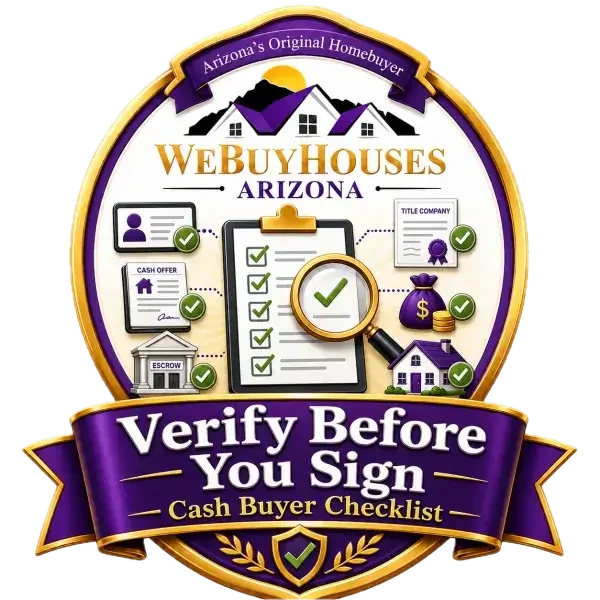
Two more checks live on our cash home buyer red flags page, and this page only points to them. Proof of funds is not a bank screenshot. It is the earnest-money receipt from a licensed Arizona title company, in your hand the day you sign. That is check 2 there. Before you call any company, look its name up at the Arizona Corporation Commission, and look up the title company it names at the DIFI license search. Those are checks 1 and 9. Both take minutes.

What a direct buyer in Arizona looks like
Stephen W. Rockwell and the team he built, trained, and stands behind have bought houses in the Phoenix metro, East Valley, and Pinal County since 1999. This is what the first machine looks like when you can see all of it.
We pay with our own money, so there is no lender, no appraisal, and no capital provider to find after you sign. There is no commission, no fee, and we pay the normal seller-side closing costs. On the day you sign, at least $5,000 of ours goes into escrow at a licensed Arizona title company, more on higher-priced houses, and the title company hands you a receipt that same day. If we fail to close under the terms of our agreement, that money goes to you. SafeClose™ puts those terms in writing.
The written price holds through closing, and most of our sales close in 7 to 14 days once the title is clear.
Every review site argues about the percentage of value a cash offer really pays. Here is our receipt instead of our argument. On more than 100 of our recent purchases we checked, every written offer was 80 percent or more of what the house would sell for as-is on the open market. Ask, and we’ll show you how we got to our number.
When Three Buyers Back Out Before a Move: San Tan Valley, April 2020
A family in San Tan Valley had a move already in motion: new jobs, a new house, a date on the calendar. Over the two months before it, two of the largest online cash-offer companies and a local cash buyer each signed an agreement to buy the house. Each backed out: three failed escrows in a row, with no warning. Title questions and the spring-2020 nerves about values were the reasons given. Three signed agreements, and nothing in any of them cost the buyer anything to walk away.
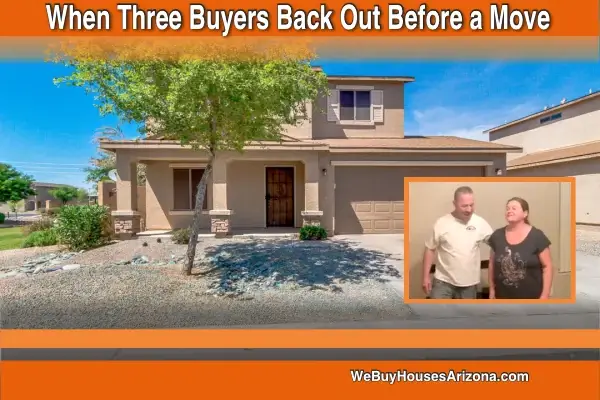
They called us with twelve days left. We set closing for day ten and closed on day eleven; a bank wire ran a day late. The moving truck was in the driveway, so Stephen W. Rockwell drove over and put cash in their hands for gas, food, and the road until the wire landed the next morning. They left on schedule. The house had plenty of equity; what it did not have was time. Question 4 would have caught all three: ask what can move the offer after you sign, and what it costs the buyer to leave.
In July 2022, a large online company canceled on a Phoenix seller the morning of her closing; she called us, and the sale closed three days on with the title work already done. That case is told in full on our red flags page, with the check that would have caught it.
Apply the same scrutiny to us that this page applies to everyone else. The BBB record shows A+ accreditation dating from April 17, 2019; the reviews sit on Google, Trustpilot, and our testimonials page; the Mesa, Apache Junction, and Chandler chambers list us as members. Then put the four questions to us.
Why I wrote this page: a note from Stephen W. Rockwell
The first iBuyer opened in Phoenix in 2014. The second followed in metro Phoenix the next year. The federal order I quoted above names a company headquartered in Tempe. This whole industry was born in my backyard, and it ran its first experiments on my neighbors. I had been buying houses here for fifteen years when the first one arrived, and I have watched every version of the online cash offer since.
I did not write this page to tell you the sites are scams. The model is legitimate. The company behind any particular form may or may not be, and the form will not tell you. What I want for you is simpler than a warning. Read the company’s own page, not someone’s review of it. Find the buyer’s name on the agreement before you sign. And never let the form know more than you do.
If a large company, or a good agent, nets you more than our written offer, I will tell you so. That has been true since 1999, and you can test it on your own house.
Stephen W. Rockwell · Who we are

Questions sellers ask about online cash offer sites


What happens when you enter your address on a cash offer website?
It depends on the machine. On a principal buyer’s site, the company prices your house and makes its own offer. On a marketplace, your address becomes a lead, the network it is sent to does the calling, and the site is paid for the introduction. The small print under the form says which.
Is the company on the website the one actually buying your house?
Only if its legal name is the buyer on the agreement and the agreement cannot be assigned without your consent. “We buy” on the site is a claim; the agreement is the proof. In Arizona, a buyer planning to assign your agreement must disclose it in writing first, or you may cancel and keep the earnest money.
Is Opendoor legit?
Opendoor is a real, publicly traded buyer that pays for houses with its own money. In 2022, it settled FTC allegations about its 2017 to 2019 marketing for $62 million without admitting wrongdoing; refunds went to 54,689 sellers in 2024. Both accounts are linked on this page. Legitimacy and value are separate questions; the written offer answers the second.
How do cash offer websites make money?
A principal buyer earns on the house: a service charge and the difference between what it pays and what it later sells for. A marketplace earns a referral fee from the agent or investor it sends you to, which is why it is free. A review site earns when you click through; some are owned by the marketplaces they rank.
Can you trust the sites that review and rank cash home buyers?
Check who owns the site before you weigh the ranking. Real Estate Witch states that it was acquired by Clever Real Estate in 2020, and Clever earns a referral fee when a sale closes through its network. Disclosed ownership is not a reason to ignore a review; it is the business model to read it with.
Who pays more, Opendoor or Offerpad?
Neither company publishes a fee percentage on its own pages as of October 2026, so any ranking by fee is someone else’s estimate. Compare the two written offers on your house, after the service charge, repair deduction, and closing costs, against what a listing or a direct buyer nets you. The headline price is not the number you receive.
What happened to Zillow Offers?
Zillow Group announced the wind-down of Zillow Offers, its cash-buying program, in its November 2, 2021 results release, citing a quarterly inventory write-down of about $304 million and further losses expected. Zillow still shows cash-offer buttons; they now route to other companies’ programs, which is the clearest example of the machine behind a button changing.
What is the difference between an iBuyer and a site that connects you with investors?
An iBuyer is the buyer: it signs the agreement and pays with its own money. A site that connects you with investors is a marketplace: it signs nothing, sends your address to its network, and is paid by whoever wins your deal. A local direct buyer belongs to the first kind, without the service charge.
Still have questions?
Call or text (480) 444-2274
Run your own check on a real buyer
You have read how online cash offer sites work; here is the other kind. Describe the house, and you get a written cash offer from the company whose name is on it. You also get a straight answer on your best path when that path is a listing or a larger buyer instead of us. The offer costs nothing and binds you to nothing. Call Stephen W. Rockwell and his team at (480) 444-2274, or put the address in the form and the callback comes from us, not a network.
Sources: company statements are quoted from opendoor.com and help.opendoor.com, offerpad.com and investor.offerpad.com, listwithclever.com, realestatewitch.com, homelight.com, and investors.zillowgroup.com, each read in October 2026 and linked where quoted; they reflect those pages on that date and may have changed since. The federal record is the Federal Trade Commission’s press releases of August 1, 2022 and April 3, 2024, linked above. Arizona’s written-disclosure requirement for assigning buyers, with the seller’s cancellation remedy, is A.R.S. § 44-5101. No company named here is accused of anything beyond what its own pages and the public record state. General information only, not legal advice; an Arizona attorney can advise on your situation.
Content by Stephen W. Rockwell, Founder of We Buy Houses Arizona™. Mesa, Arizona. Est. 1999. BBB A+ Accredited.
We Buy Houses Arizona™, 7726 E. Baseline Rd. Unit 203, Mesa, AZ 85209, (480) 444-2274