
Last updated: July 2026. The offer math on this page reflects the method we run on every house, built from MLS and Cromford Report data, and our track record is verifiable through the BBB and Google profiles linked at the bottom of this page.

When a cash buyer hands you an offer, the real question is where the number came from. Most cash buyers will not show you. They run a quick percentage, quote it, and the number can still move at the closing table.
We do it the opposite way. Every offer We Buy Houses Arizona™ makes runs through the same underwriting method Stephen W. Rockwell has built buying houses here since 1999: our Seller Option Underwriting Platform, or SOUP™. It weighs the five inputs that actually decide what a house is worth to a direct buyer, and it produces a number we have already confirmed we can close on, in writing, at the price we showed you.
This page walks through exactly how that works, input by input, with a full example you can follow. Read it, check the math against your own house, then call us. Call or text (480) 444-2274.

The short answer. A fair cash offer is built backward from what your house will sell for after it is renovated, minus the cost of that work, the cost of carrying and reselling the home, and a fair margin for doing it. It is not a percentage. We Buy Houses Arizona calculates every offer with a method called SOUP, the Seller Option Underwriting Platform, which replaces the industry’s one-size 70% rule with five real inputs and gives you options instead of a single take-it-or-leave-it number. On a home worth $500,000 fully renovated that needed about $98,000 of work, that method produced a firm cash offer of $275,000, roughly $23,000 more than the 70% rule would have paid.

Since 1999
 Helping Home Sellers
2,000+
 Local Homes Bought
A+ Rated
 Better Business Bureau
What SOUP™ Is, and Why We Skip the 70% Rule
SOUP stands for Seller Option Underwriting Platform. Both halves of that name are deliberate. It underwrites the house on real numbers, and it exists to give you options, not just a number. It is the method Stephen W. Rockwell has built buying houses in Arizona since 1999, and every offer We Buy Houses Arizona makes runs through it before you ever see a number.
Most cash buyers do not work this way. They use the 70% rule: take 70 percent of a home’s after-repair value, subtract estimated repairs, and quote what is left. It is fast, and speed is the only thing it has going for it. A number pulled from a single percentage is a starting point for negotiation, not a price anyone has confirmed they can close on. That is why offers built on a formula so often move at the closing table. A single percentage was never a firm number to begin with, so there is always room for it to slide after an inspection.
SOUP replaces the single multiplier with five real inputs, each confirmed before the offer is written:
Neighborhood comps. Recently sold homes pulled from the MLS in your specific neighborhood, matched apples to apples to your house: similar year built, square footage, number of stories, pool or no pool, level of upgrades, and the overall condition of the windows, floors, roof, and AC. A metro-wide average or a Zillow estimate cannot do that.
Component-level repair costs. Repairs priced line by line, not guessed by the square foot: roof, HVAC, plumbing, electrical, flooring, kitchen, bathrooms, and finishes. Every offer starts from a full scope of work with a real itemized budget and a schedule.
Holding costs. Property taxes, insurance, utilities, and the carrying time between purchase and resale, all of it real money.
Title and escrow variables. Payoffs, liens, and HOA balances confirmed up front, so nothing surfaces at closing that changes your number.
Your timeline. A seven-day close and a sixty-day close are different math, and both are workable. Your timeline is an input, not an afterthought.

The part the 70% rule misses: what a house is worth depends on what happens to it next. After-repair value is not one fixed number. It depends on how far the renovation goes and what the house becomes. We work in three renovation levels, Good, Better, and Beautiful, up to a full gut when a house needs it, and a property’s price point and location usually point it toward one. End use matters just as much. A full renovation for resale is a different scope, and a different after-repair value, than bringing a house up to standard for a quality rental. We confirm which path a house is on before we build the number, then run those factors through SOUP so the offer lines up with the property’s real future use, not a generic estimate.
This is exactly where the 70% rule breaks down. It applies one after-repair value to every house, as if finish level, condition, and end use did not change what the home is worth once the work is done. They change everything, and an offer that ignores them is a guess dressed up as a formula.
So when sellers ask how much a cash buyer will pay for a house, the honest answer is that it depends on those factors, not on a percentage.

How We Establish Value: A Full Market Analysis, Not a Guess
Every number in a SOUP offer starts from one question: what will this house actually sell for once the work is done? Get that wrong and everything downstream is wrong. So this is the input we spend the most on, and it is where our method looks least like everyone else’s.
Most buyers run comps off a free website, take the estimate it spits out, and move on. We do not use automated estimates for this. We pull from the MLS and the Cromford Report, the same professional-grade data the best agents in Arizona rely on, and we build a full Comparative Market Analysis on your house.
A real CMA is not a list of nearby sales. It is a complete read of your hyper-local market, the subdivision or the few streets around you, not a metro average:
- Sold comparables, matched apples to apples on age, size, stories, pool, upgrades, and condition, so we are comparing your house to houses actually like it.
- Active and pending listings, because sold data alone is only the past. What is on the market right now, and what is pending, tells us what your house will be competing against when it is finished. Pricing off sold comps only, and ignoring what is active and pending, is reckless.
- Genuine comparables or lemons, since some actives and pendings are truly like your house while others are overpriced listings sitting unsold, so we do not anchor your value to homes that will never sell at their asking price.
- Market direction, trending up or down, and how fast.
- Days on market, so we know how long homes like yours are really taking to sell.
- Asking price versus sold price, the gap between what sellers hope for and what buyers actually pay.
- Seller concessions, because a sale price with $15,000 in concessions behind it is not really that sale price.
Put together, that is the full picture: not just what a house like yours sold for, but what the market is doing and what to expect when the renovated home goes back up for sale. That is how we set an after-repair value we can stand behind, which is the foundation the rest of the offer is built on.
Here is the contrast that matters for you. Many agents do the opposite. They pull a few loose comps, suggest a high “starting” list price to win the listing, and then walk the seller through price drop after price drop until the house finally sells for what the data said all along. We gather this data to price the house right the first time, and to know what to expect before we commit, not to talk anyone into a number that feels good today.






The Real Math: The Same House, Priced Two Ways
The fastest way to see the difference is to run one house through both methods. The numbers below are a representative example, not a specific sale, but the math is exactly how each approach works. Before the numbers, here is how the two approaches differ at a glance:
| The 70% Rule | The SOUP Method | |
|---|---|---|
| After-repair value | Often a quick or automated estimate | Full CMA from MLS and Cromford Report: sold, active, and pending |
| Repairs | Estimated, often guessed | Counted line by line from a real scope of work |
| The formula | One flat 30% cushion on every house | Real holding, resale, timeline, and end use |
| End use | Ignored, one value for every house | Built in: resale or rental, Good through full gut |
| Does the number hold? | Often renegotiated after inspection | Confirmed up front, verified before you see it |
| What you get | One number, no options | A firm offer plus options, including listing |
| Result on the example home | $251,905 | $275,000 |
The house. A 1990s single-story in a Mesa neighborhood, about 1,700 square feet, three bedrooms, two baths, with a pool. Sound structure, but dated: original kitchen and baths, an aging roof and AC, worn flooring throughout. Comparable remodeled homes nearby, matched on age, size, and features, have recently sold around $500,000. That is the after-repair value, the number the house is worth once the work is done and it is competing with those remodeled comps.
The repairs, priced line by line. This house is going to a full resale-grade renovation. Instead of multiplying square footage by a flat per-foot rate, We Buy Houses Arizona prices every component from a real scope of work:
| Scope item | Estimated cost |
|---|---|
| Roof | $12,000 |
| HVAC and water heater | $9,000 |
| Kitchen (cabinets, countertops, appliances) | $15,625 |
| Bathrooms | $8,100 |
| Flooring throughout | $7,538 |
| Interior and exterior paint | $6,450 |
| Electrical | $2,435 |
| Plumbing | $4,610 |
| Windows | $1,150 |
| Landscape and pool | $6,000 |
| Remaining scope (demolition, drywall, insulation, garage, finishes, hardware) | ~$25,187 |
| Total renovation budget | $98,095 |
That total is not a round number, because it was not a guess. It is a real budget with a real schedule behind it, priced item by item before the offer is ever written. And to make the comparison below fair, it is the exact same repair figure we hand to the 70% rule. Same house, same work, same $98,095. The only thing that changes is the method.
Why the guess is the problem, and why it lands on you. Most cash buyers never build a sheet like this. They eyeball the house and estimate repairs in their head. Across thousands of offers reviewed since 1999, the pattern is consistent: on a house whose real budget is near $98,000, a quick guess lands nowhere close, usually around $70,000 or around $120,000. And here is the part sellers miss. A wrong repair number hurts you no matter which way it misses.
Guess high, and that inflated figure becomes the excuse for a lower offer. A common shortcut is to price the whole renovation at a flat rate per square foot by finish level, then tack the big-ticket items like roof and AC on top of that. On a house like this it can push the “repair” number well past $120,000, and the higher that number climbs, the lower the offer to you falls. The overestimate is not an accident; it is leverage.
Guess low, and the danger is hidden, which makes it worse. A $70,000 estimate produces an offer that looks generous enough to sign, but it cannot survive real costs. A wholesaler is not the end buyer of your house; someone else is, and that buyer eventually prices the work for real. When it turns out closer to $100,000, the deal no longer pencils at the price you were promised. Weeks later you are back at the table being asked to come down, or the deal quietly dies. Either way you have lost the time you could not afford to lose.
The number only holds if it was counted, not guessed. That is the whole reason we price every component before we write the offer.
Path one: the 70% rule.
| 70% rule | |
|---|---|
| After-repair value | $500,000 |
| 70% of ARV | $350,000 |
| Minus repairs | −$98,095 |
| Offer to seller | $251,905 |
That is the whole calculation. The 70% rule bakes a flat 30% cut off the top to cover repairs, holding, resale costs, risk, and profit all at once, in one blunt number. It is quick, but that blunt cushion is doing the work a real analysis should do.
Path two: SOUP. SOUP starts from the same ARV and the same itemized repairs, then accounts for the actual carrying costs over the roughly five months of renovation and resale, the real closing and resale commissions, and a fair margin for doing the work. Because those real costs come in under the 70% rule’s blunt 30% cushion, and because we renovate and resell the home ourselves rather than pricing in layers of middleman margin, there is room to pay you more:
| Same house | 70% rule | SOUP |
|---|---|---|
| After-repair value | $500,000 | $500,000 |
| Itemized repairs | $98,095 | $98,095 |
| Offer to seller | $251,905 | $275,000 |
| Difference to you | +$23,095 |
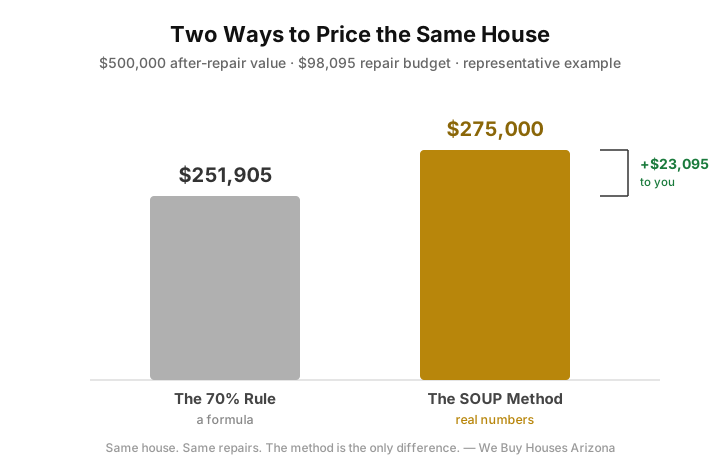
Same house. Same repairs. Same ARV. $23,095 more in your pocket, because the number was built from real costs instead of a shortcut. And because every input was confirmed before the offer was written, that $275,000 is a figure we have verified we can close on, in writing, not an opening bid that erodes at the table.
That is the entire argument for doing the math the hard way. A formula gives you a number fast. SOUP gives you a number that is both higher and real.
SOUP Gives You Options, Not Just a Number
The “Option” in Seller Option Underwriting Platform is not filler. Once SOUP has analyzed your house closely enough to know what it is worth and what it could become, that same analysis can shape a deal more than one way. So instead of a single take-it-or-leave-it figure, you usually get a few paths, laid out side by side, and you choose.
One path might be the fastest possible close, cash in hand in about a week. Another might trade a little speed for a stronger price, or set closing on a date months out because that is what your move actually requires. Another might pair the sale with our Soft Landing™ program, so you stay in the home for a short time after closing at no cost while you get your next step in order. Different sellers need different things, and the point of laying the options out is that the right one is yours to pick, not ours to assign.
And sometimes the honest option is not selling to us at all. If SOUP shows that listing your house on the open market would genuinely put more money in your pocket, and your situation gives you the time to do it, we will tell you so, and explain why. That is a real recommendation, not a courtesy, and it is written into our Seller Bill of Rights.
But telling you to list only helps if you know who should list it. One of the most common and most costly mistakes sellers make is hiring an agent they happen to know, a relative, a neighbor’s friend, someone from church, who may have sold only a handful of houses and rarely works in your area. The wrong agent can cost you far more than a commission. Since 1999 we have worked alongside a lot of agents, and we know which ones are the real thing. When listing is genuinely your best move, we will point you to one of our Vetted Agents: full-time professionals, typically with 20 or more years in the business or 500-plus closings, who are highly skilled and treat people right. You still choose, but you start from a short A-list of agents we would trust with our own family’s sale, not a name pulled from a search you have no way to judge.
Most cash buyers run one model. They buy houses one way, for one purpose, and every house that comes through the door gets forced into that single mold whether it fits or not. The offer serves the buyer’s need, and the seller is handed one number and a deadline. SOUP was built to do the reverse: analyze the house precisely, then map the realistic exit strategies, walk you through the pros and cons of each, and let you make an informed decision with the full picture in front of you.
That is also why SOUP holds up across very different situations. A looming foreclosure date, an inherited house two states away, a rental you are tired of managing, a home that needs far more work than you want to put in, each one changes which options make sense, and SOUP is built to weigh them rather than ignore them. The inputs are the same. What changes is which path wins, and that is the part you decide.
Want to see the full side-by-side of cash versus listing versus an iBuyer? We lay out all three honestly, including the row where another path beats us.
A Note From Stephen W. Rockwell
I built SOUP because I got tired of watching sellers get handed a number nobody could stand behind.
When I started buying houses in Arizona in 1999, the fast-cash corner of this business already had a reputation, and it earned it. Quote a big number, get the house under agreement, then chip away once the seller is committed. It works right up until the seller figures out what happened, and by then the closing table is the only place left to fight about it. I decided early that I would rather do more math up front and never have that conversation.

That is all SOUP really is: the discipline to price the house honestly before I put a number in front of you, instead of after. Comps matched to your actual house. Repairs counted line by line, not guessed. The real costs of carrying and reselling the home, because we are the ones who renovate and resell it, not a middleman flipping the paperwork. And a set of options laid out plainly, including the times the honest answer is that you should list with a great agent instead of selling to me at all. I would rather lose that deal than win it dishonestly.
Two thousand-plus houses later, the method has not changed, and neither has the standard I hold the team I built and trained to. The number we show you is the number we close on. If we ever miss that, I want to hear about it.
— Stephen W. Rockwell, Founder, We Buy Houses Arizona™. Buying houses across Arizona since 1999
Frequently Asked Questions


How much do cash buyers pay for a house?
It depends on the house, but the honest range is easy to explain. A cash buyer’s offer works backward from what the home will sell for after it is renovated, minus the cost of that renovation, the cost of carrying the home, and the costs of getting it sold again. On the example above, a house with a $500,000 after-repair value that needs $98,095 of work supported an offer of $275,000. What separates a good offer from a bad one is not the percentage. It is whether the number was built from real comps and a real repair budget, or guessed. See our full breakdown above.
Do you use the 70% rule?
No. The 70% rule takes 70 percent of after-repair value, subtracts estimated repairs, and calls it an offer. It is fast, but it applies one blunt cushion to every house and ignores what actually drives value: the specific condition, the finish level the home is headed to, the real carrying costs, and your timeline. On the same house, the 70% rule produced an offer $23,095 lower than ours. We price with a full market analysis and a line-by-line repair budget instead.
What is the 70% rule in real estate?
It is a shortcut investors use to make fast offers: multiply a home’s after-repair value by 70 percent, then subtract estimated repair costs, and the result is the offer. The 30 percent held back is meant to cover repairs, holding costs, resale costs, risk, and profit all at once. It is quick, which is its only real advantage. Because it leans on a single percentage and a guessed repair number, offers built on it frequently change once an inspection happens. That is the gap SOUP was built to close: real comps and a counted repair budget in place of one blunt multiplier.
How do you decide what my house is worth?
We build a full Comparative Market Analysis from MLS and Cromford Report data, not a free online estimate. We look at sold, active, and pending homes in your specific neighborhood, matched apples to apples on age, size, stories, pool, upgrades, and condition, plus market direction, days on market, list-to-sold ratios, and concessions. That tells us what your renovated home will realistically sell for, which is the foundation of your offer.
How much less than market value do cash buyers pay?
Less than a fully renovated home would sell for, yes, but that is the key distinction. A cash buyer is not offering less than your house is worth today in its current condition. The offer is based on what the home will be worth after it is renovated, minus the cost of that renovation and the costs of buying, holding, and reselling it. On our example home, a $500,000 after-repair value that needed about $98,000 of work supported a $275,000 cash offer. You are trading the retail price, which requires you to make the repairs, wait months, pay commissions, and carry the home, for a firm price and a fast, certain close.
Should I accept a cash offer for my house?
It depends on what the offer is really worth to you, not just its face value. A firm cash offer that closes on your timeline can be worth more than a higher number that gets renegotiated or falls through, especially if you are selling on a deadline. The biggest offer is not always the best one; the best one is the offer a buyer can stand behind from the day you accept to the day you sign. Before you accept any offer, it is worth putting the buyer to a few direct questions, which we lay out just below.
Will the offer change after I accept it?
That is exactly what SOUP is built to prevent. Because we confirm the comps, the repair scope, and the known title variables up front, the offer is a figure we have already verified we can close on, in writing. The number we show you is the number we close on.
Can a cash offer fall through?
It can, and it is worth understanding why. Most cash offers fall through for one of two reasons: the buyer guessed at the numbers and had to renegotiate once real costs surfaced, or the buyer never had the money to close in the first place. SOUP is built to remove the first risk by confirming the comps, the repair scope, and the title details before the offer is written. The number we show you is the number we close on.
What if selling to you is not my best option?
Then we will tell you. If a full market analysis shows that listing your house would put more money in your pocket and your situation gives you the time, we will say so and point you to one of the vetted agents we trust. You choose the path. Laying out your real options, including the ones that are not us, is the whole reason the platform is called a Seller Option Underwriting Platform.
Still have questions?
Call or text (480) 444-2274
3 Questions to Ask Any Cash Buyer Before You Accept
Whoever you sell to, these three questions separate a real offer from a guess:
How did you calculate this offer? A real buyer can walk you through the comps and a line-by-line repair budget. A guess can only be defended, not explained.
Is the price firm and in writing, and what happens if the inspection finds something? The number you accept should be the number you close on.
How long have you been buying houses here, and can I verify it? An established buyer welcomes the question. Check the Better Business Bureau and read the reviews.


See the Number for Yourself
The fastest way to understand what your house is worth to a direct buyer is to let us run it through SOUP. We will build the comps, price the repairs, and show you a firm cash offer, along with the honest options around it, even when that path is not us. No pressure, and no obligation to take it.
Before you call us, or any cash buyer, verify who you are dealing with. Check the Better Business Bureau, read the reviews, and ask how the offer was calculated. We are happy to walk you through every line of yours.
Hours: Available 24/7. Live or assisted response any time.
Rather talk it through? Call or text (480) 444-2274. We buy houses across Arizona, and we have since 1999.
Want the bigger picture first? See how we buy houses, start to finish.
Content by Stephen W. Rockwell, Founder of We Buy Houses Arizona™. Mesa, Arizona. Est. 1999. BBB A+ Accredited. Updated July 2026.