

A legitimate cash home buyer in Arizona is a company that pays for your house with its own money, puts earnest money into escrow at a licensed Arizona title company, and closes there on the date you agreed. Selling that way is legal and common. The warning signs on this page are about the buyer, not the method: the one who talks cash and has none, the offer that shrinks after you sign, the middleman hidden in the agreement, the deed that moves before the money. Twenty-one signs to spot them, nine checks to verify any buyer, and our own answer under every check.
Short on time? Go straight to the nine checks.

Is Selling Your House to a Cash Home Buyer in Arizona a Scam?
No. Selling for cash in Arizona is sound; the person offering it is what you check.
Call Stephen W. Rockwell and his team at (480) 444-2274 if you would rather talk it through than read.
Arizona homeowners sell directly for cash every day, to settle an estate, to stop a foreclosure, to leave a house that needs more work than they can take on, or simply to skip the showings and the waiting. The buyer pays from their own account, so there is no lender or appraisal to wait on, and the sale closes through the same licensed title company that handles any other sale in the state.
The trouble is that nothing stops anyone from using the words. No license or experience is required to call yourself a cash home buyer, so the same three words, “we buy houses,” cover both a company that has bought thousands of homes and someone who took a weekend course last month and is learning on your house. They use the same slogans and the same friendly voice. From the outside, you cannot tell them apart, and that is exactly how the bad ones do their damage.





We Buy Houses Arizona™ has bought more than 2,000 Arizona houses since 1999. Stephen W. Rockwell and the team he built, trained, and stands behind have watched every play on this page run against real sellers, and have sat across the table from people cleaning up after one. So this page does two things. It shows you the warning signs, in plain words, with the question to ask at each one. And it gives you nine checks you can run on any buyer, with our own answer printed under each, because a buyer with nothing to hide should be the easiest one to check.



Since 1999
 Helping Home Sellers
2,000+
 Arizona Homes Bought
A+ Rated
 Better Business Bureau
Is It Illegal to Sell a House for Cash in Arizona?
No. A cash sale is an ordinary real estate sale with no loan in it. The buyer is not borrowing from a lender, so there is no appraisal and no loan approval. Everything else is the same as any sale: a written agreement, a title search, a licensed Arizona title company running escrow and recording the deed, and your money coming to you from that title company, never through the buyer’s hands.
Arizona law adds two protections worth knowing before you sign. A buyer who intends to hand your agreement to someone else must tell you so in writing before it binds; if they do not, you may cancel before close of escrow, without penalty, and keep the earnest money (A.R.S. § 44-5101). And the title companies that hold your earnest money are licensed escrow agents regulated by the Arizona Department of Insurance and Financial Institutions, so the money sits with a regulated third party, not with the buyer. What makes a cash sale safe is that structure, not trust, and every check below confirms a piece of it.


Cash Home Buyer Red Flags in Arizona: 21 Warning Signs
These are the signs we have watched cost Arizona sellers money, time, and the sale itself. They fall into four questions. Learn the question, and you will recognize a version of the trick you have never seen before. Each sign ends with the tell and the number of the check that exposes it.
Is There a Real Buyer Behind the Offer?
1. The “No Cash Clown.” They talk about cash and have none. The money was always going to be a lender who has not committed, a partner who has not said yes, or a buyer they have not found. The tell: no earnest money in escrow, no title company named, and no closed houses they can point to. Check 2 and check 8.
2. The buyer who never opens escrow. They sign your agreement, tie the house up, and go quiet. They are shopping it to someone else, and if nobody bites, the deal dies with your weeks inside it. For a seller with a foreclosure date or a move already booked, those weeks are the whole sale. The tell: a real buyer opens escrow at a licensed Arizona title company and deposits earnest money right away; silence in the first days is the signal. Check 2.
3. The Daisy Chain. Your agreement is passed down a line of middlemen, each taking a slice, and the price and closing date change hands with it. Arizona law says a buyer who intends to do this must tell you in writing first. The tell: ask, “Are you the buyer, and if you ever bring in a partner, do my price, terms, and closing date stay exactly the same?” Check 3.
4. The lead seller in buyer’s clothing. A polished website that buys nothing. You fill in the form, and your information is sold to whoever pays for it, which is why four strangers call the next morning. The tell: ask, “Will your company buy and close on my house, or are you passing my information to someone else?” Check 3, and see how the online cash-offer sites work.
5. The buyer you cannot look up. No named person, no office address, no business you can find in a few minutes of looking. A company that will not be found does not want to be found afterward. The tell: nothing at the Corporation Commission, no address, no one willing to put their name on the offer. Check 1.
Will the Offer You Sign Be the Offer You Close?
6. The high offer that shrinks. A number built to beat every other offer and win your signature, with no intention of closing at it. Once you have stopped talking to other buyers, it comes down. By then you have told the other buyers no, and starting over costs more than the cut. The tell: an offer noticeably above the rest with nothing to justify it. Check 4.
7. The pre-closing nitpick. Days before closing, the inspection “finds” things, and the price has to come down. The discoveries are leverage, not surprises, timed for when you are packed and out of options. The tell: an as-is buyer prices the house as-is, up front; ask what could change the price after you sign, and get the answer in writing. Check 4.
8. The clock-runner. Delay after delay, each with a reason, until your own deadline arrives and you will take anything. The delays are aimed at your deadline, not theirs. The tell: watch the first days after signing. Escrow opened, earnest money in, title ordered. If none of that has happened within a few days, nothing is happening. Check 2.
9. The Instant Offer. A number from a form that has never seen your house is bait in both directions: high enough to hook you, or low enough to anchor you. A real number comes after someone has walked the house. The tell: ask what the number is based on, and how a written offer is actually built. Check 4.
Do They Actually Know What They Are Doing?
10. The renovation number they made up. “It needs sixty thousand dollars of work” with no scope behind it. A repair figure with no work attached is a discount with a costume on. The tell: ask what work the number covers. We buy as-is. When the repairs are large, we tell you what work the house needs and what the whole renovation should cost us, as a range. If another buyer gives you a repair number, ask what work it covers. Check 4.
11. The do-the-math claim. Tens of thousands of houses bought, decades in business. Run the arithmetic: that many houses means closing several every week, without a break, for longer than they have existed. When the number is not possible, it is marketing. The tell: do the math, then check the public record. Check 8.
12. The agent who became a “buyer” yesterday. Years of listing houses are not years of buying them, and in Arizona, a company buying for its own account needs no real estate license at all, so a license proves nothing either way. The tell: ask how long they have bought houses directly, and how many. Check 8.
13. The reckless newcomer. Not a crook, just learning on your house, which costs you the same. The tell: experience shows up in specifics. Ask how they handle a title problem, a payoff, an HOA, a closing date that has to move. Vague answers are the answer. Check 8.
14. The reckless “subject-to.” They take over your mortgage payments instead of paying the loan off at closing. The loan stays in your name; if they stop paying, the lender comes to you. The tell: anything other than your loan being paid off at closing; understand exactly who stays liable before you sign. Check 5 and check 9.
Are They Rushing You, or Hiding Something in the Paperwork?
15. The fine-print fee. A “processing fee” or “service fee” that appears on the closing statement after the price was agreed. The tell: ask, “Are there any fees that come out of my proceeds, and will you put that in writing?” Then make sure the closing statement matches. Check 6.
16. The pressure to sign now. The offer expires tonight. Someone else is interested. Urgency is manufactured to stop you reading. The tell: a real buyer gives you room to read, to ask, and to have someone you trust look it over. Check 5.
17. The blank or “and/or assigns” agreement. Blanks get filled in later, by someone else. The three words “and/or assigns” mean the person signing may not be the person buying. Arizona law requires that to be disclosed in writing; if it was not, you can cancel before close of escrow and keep the earnest money. The tell: nothing blank, and nothing you do not understand. Check 3 and check 5.
18. The missing signature. One legal owner left off the agreement: a co-owner, an heir, a spouse, and the sale cannot close no matter what anyone promised. You find out at closing, after the weeks are already spent. The tell: every person with legal ownership named and signing from the start. Check 7.
19. The deed before the money. “Sign the house over to us now, and we will catch up your mortgage,” or “put it in this trust and we will stop the foreclosure.” You sign a deed, they own the house, and the money never arrives. In 2025, the Arizona Attorney General sued operators over schemes built on exactly this. The tell: ownership changes hands once, at closing, through a licensed Arizona title company, when you are paid. Check 7 and check 9.
20. The closing they want to control. Their “title person,” their paperwork, their wiring instructions. A closing you cannot see into is a closing you cannot trust. The tell: a licensed, neutral Arizona title company you chose or can look up, and payoff and proceeds instructions that come from that title company, confirmed by a phone number you found yourself. Check 9.
21. The clickbait crown. “Arizona’s #1 home buyer,” “highest offer,” “most trusted,” a dozen companies wearing the same crown. They cannot all be number one; those are paid slogans. The tell: ignore the crown and check the receipts. Check 8.

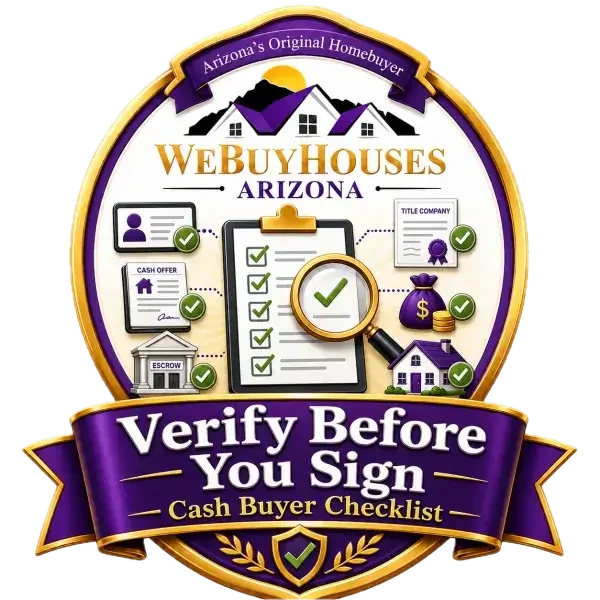
How to Verify a Cash Home Buyer in Arizona: Nine Checks
You do not need to memorize twenty-one signs. Nine checks, most of them a few minutes each, expose every one of them, and every check points to a public record you can open yourself. Run every one of them on us: our answer is printed under each.
1. A real person, a real address, a real history. Search the business name at the Arizona Corporation Commission. You should find a registered business and a named person behind it, and an office address you could drive to. A buyer who will not be found now does not plan to be found later.
Our answer: founded by Stephen W. Rockwell and operated from Mesa since 1999, at 7726 E. Baseline Rd., Unit 203, Mesa, AZ 85209.
2. Earnest money into escrow, with a receipt. Once the agreement is signed, escrow opens at a licensed Arizona title company and the buyer deposits earnest money there, and the title company gives you a receipt for it. That receipt is the proof that money exists and is committed to your sale. Confirm the title company is licensed at the DIFI license search.
Our answer: the day the agreement is signed, our earnest money goes into escrow at a licensed Arizona title company and you get the receipt the same day. If we fail to close under the terms of our agreement, that money goes to you. That is the SafeClose Program.
3. A straight answer on who is buying. Ask whether the company in front of you is the one that will buy and close, and whether your price, terms, and date can change if anyone else is brought in. Arizona requires a buyer who intends to assign your agreement to disclose it in writing before it binds (A.R.S. § 44-5101).
Our answer: you will always know exactly who is buying your house. On the rare occasion we bring in a partner, your price, your terms, and your closing date do not change, ever, and the arrangement is explained on our company page.
4. A written offer, in plain language, that holds. The offer should be in writing, say what it is based on, and state what, if anything, could change it before closing. “Subject to inspection” with no limits means the price is not real yet.
Our answer: the price in your written offer holds unless you did not disclose something material. The Seller Bill of Rights™ puts that, and nine other commitments, in writing, and how we build the number is published.
5. An agreement you can read, with nothing hidden. Read every line before you sign. No blank fields, no “and/or assigns,” no inspection period that never ends, no approval condition that can never be met. If you do not understand a line, it does not get signed until you do.
Our answer: nothing on our agreement is blank when you sign it, and we will walk you through every line.
6. No hidden fees. Ask what comes out of your proceeds, and get it in writing. Then compare the closing statement to the answer.
Our answer: no commission, no fee, and we pay the normal seller-side closing costs. Escrow deducts only what the house already owes, a loan payoff or back taxes, the same as in any sale.
7. Every legal owner accounted for, and the deed moves once. Who owns a house is public at the county recorder; Maricopa County’s document search is free online, and Pinal County keeps its own. Every owner of record signs, and the deed is recorded once, at closing, after you are paid. Maricopa’s free Title Alert tells you the moment anything is recorded against your name.
Our answer: we confirm the owner of record from county records before the offer, and every person with legal ownership is on the agreement from the start.
8. A track record that survives the arithmetic. Ask how long they have bought houses, and how many, then check whether it holds up: business records, reviews accumulated over real years, a history you can actually find.
Our answer: more than 2,000 houses in the Phoenix metro, East Valley, and Pinal County since 1999, and more than 1,000 renovations overseen in that time, numbers you can do the math on and check against the public record.
9. A licensed, neutral Arizona title company. Ask which title company will run the closing, and look it up at DIFI. The title company holds the earnest money, runs escrow, records the deed, and sends your proceeds. Nothing about your closing should depend on trusting the buyer.
Our answer: every sale closes through a licensed Arizona title company, primarily Empire Title Agency, and also Pioneer Title Agency and First American Title.
One distinction to keep straight: reviews, a BBB rating, and chamber memberships prove a company is real and how it has treated people. They do not prove it has the cash to close. The earnest-money receipt in check 2 is the funding proof; the rest is identity proof. If a buyer has already cost you, the Arizona Attorney General takes consumer complaints online.
Where to check us, right now: We Buy Houses Arizona™ has been accredited A+ with the Better Business Bureau since April 17, 2019. Our reviews are on Google and Trustpilot, collected on our testimonials page, and we are members of the Mesa, Apache Junction, and Chandler chambers of commerce. Then run checks 1 through 9 on us the same way you would on anyone else.

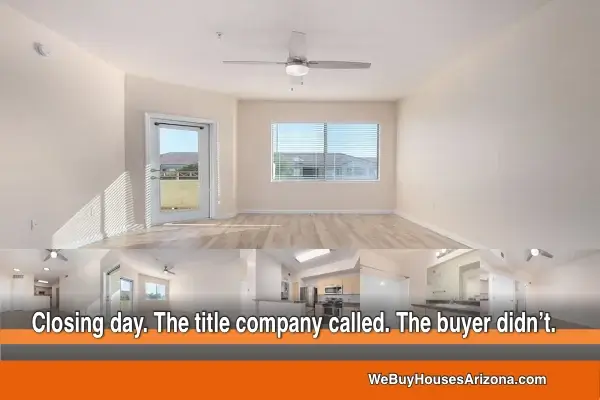
When the Buyer Cancels on Closing Day: Phoenix, July 2022
A seller had a signed agreement with one of the large online cash-offer companies. Title work done, closing day set, the truck packed for a move across the country and a wedding the following week. On the morning of closing, it was the title company that called her, not the buyer: the company had canceled, with no reason given, and nothing in the agreement required one.
She called us. We bought the condo at the same net the failed sale would have paid and closed three days later at the same title company, because the title work was already finished. We still own that condo today, as a rental. What would have caught it: check 5. A closing date is only a commitment when walking away costs the buyer something.

Frequently Asked Questions


Is it illegal to sell a house for cash in Arizona?
No. Selling your house for cash is legal in Arizona and common. The buyer pays from its own account instead of a loan, and the sale still closes through a licensed title company that records the deed and pays you. A.R.S. § 44-5101 adds one protection: a buyer who plans to assign your agreement must tell you in writing.
Is selling to a “we buy houses” company a scam?
The model is legitimate; the company may or may not be. Anyone can use the words, so the name tells you nothing. What does: earnest money in escrow at a licensed title company with a receipt, a written price that holds, and a real person and business you can find behind the offer.
How can I verify a cash home buyer in Arizona is legitimate?
Look the business up at the Arizona Corporation Commission, confirm the title company at the DIFI license search, and ask for the earnest-money receipt once escrow opens. Ask who is actually buying, what could change the price, and what comes out of your proceeds, each in writing. A legitimate buyer answers all of it without flinching.
What are the biggest red flags of a fake cash home buyer?
No earnest money in escrow. An agreement with blanks or the words “and/or assigns.” A high offer that drops after the inspection. Pressure to sign tonight. A buyer you cannot find in any public record. And any request to sign the deed over before you are paid, which is the pattern behind the Arizona Attorney General’s 2025 lawsuits.
Should a cash home buyer show proof of funds?
Yes, ask. Then ask for the thing that proves it: the earnest-money receipt from the title company once escrow opens. A bank letter is a snapshot the buyer produced; the receipt is issued by a licensed title company, carries a date, and ties the money to your sale.
Will I owe any fees when selling to a cash home buyer?
You should not. A legitimate direct cash buyer charges the seller no commission and no fee, and pays the normal seller-side closing costs. What escrow subtracts is what is already owed against the house, such as a loan payoff or back taxes. Ask the question in writing and compare the closing statement to the answer.
How do I know if a cash buyer can actually close?
Watch the first few days. A buyer who can close opens escrow at a licensed Arizona title company, deposits earnest money, and orders title promptly, and you hold the receipt. Silence after signing, a missing deposit, or a closing date that keeps sliding means the money was never there.
Still have questions?
Call or text (480) 444-2274
Ready to Run Those Checks on a Real Buyer? Start With One Call
Tell us about your house, and you will have a real, written cash offer and an honest answer about your best path, even when that path is not us. There is no charge for the offer and no obligation to accept it, and every check on this page holds up when you run it on us. Call Stephen W. Rockwell and his team at (480) 444-2274, or leave the address in the form below, and we will call you.
Sources: the wholesale-buyer disclosure rule and the seller’s right to cancel are A.R.S. § 44-5101. The license exemption for a company buying its own property is A.R.S. § 32-2121. Arizona escrow agents are licensed under A.R.S. Title 6, Chapter 7 (DIFI). The 2025 equity-stripping lawsuits are published by the Arizona Attorney General. Business records come from the Arizona Corporation Commission; ownership records from the county recorder; accreditation from the Better Business Bureau. The warning signs on this page come from our own Arizona purchase record since 1999, not from a third-party study. This page is general information, not legal advice; for your situation, talk to an Arizona attorney.
Content by Stephen W. Rockwell, Founder of We Buy Houses Arizona™. Mesa, Arizona. Est. 1999. BBB A+ Accredited.
We Buy Houses Arizona™, 7726 E. Baseline Rd. Unit 203, Mesa, AZ 85209, (480) 444-2274