
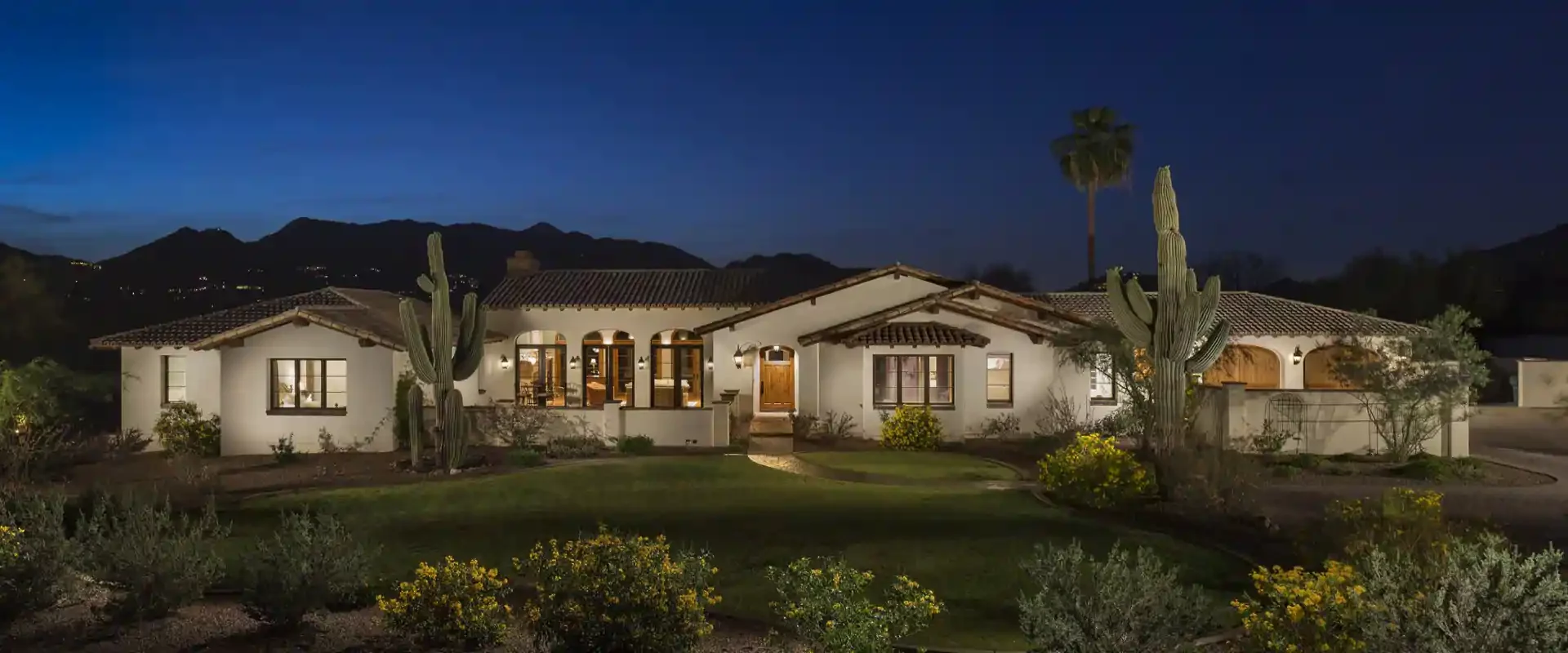
Arizona’s Direct Cash Home Buyer Since 1999
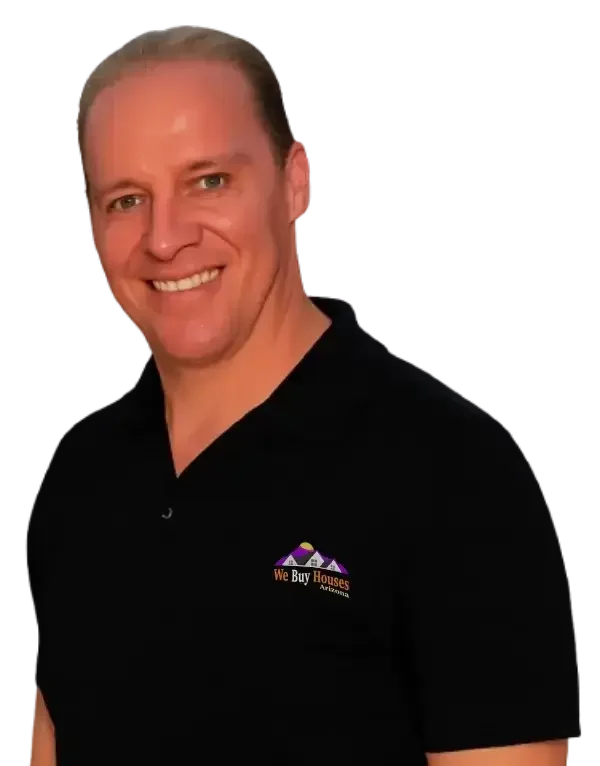
Stephen is not a real estate agent. He is not a wholesaler assigning contracts blindly to third-party buyers. He is not a franchise operator, nor is he an iBuyer algorithm. He is a direct buyer. Every offer comes from his own funds or his private investors. Nearly every time he closes, he puts the property into one of his holding companies. Every seller who has done business with We Buy Houses Arizona has worked with Stephen personally or with a team he built, trained, and stands behind.
Twenty-seven years. Same owner. Same company. Same state. Same mission, since the beginning.

The Beginning — A Worm Shop in Michigan
Stephen was born in Michigan and grew up north of Detroit in a small boating community. His father was a fisherman. Stephen watched his dad go out back and pick nightcrawlers out of the yard. That quiet routine went on for years, and somewhere in the middle of it, an eight-year-old started doing the math. The local bait shop was charging fishermen a dollar a dozen for worms that came free out of the ground. Factory workers were spending their weekends on the water, paying a premium for something nobody needed to pay a premium for.
His childhood up to that point had been difficult in ways that shaped everything that came after it.
At age seven, he was struck by a car traveling at high speed. The accident fractured his neck, caused a serious head injury, and left him with scars, permanent hearing loss, and severe tinnitus, conditions he has lived with for nearly fifty years. Teachers mistakenly diagnosed the hearing loss as a learning disability. He was bullied through grade school and middle school in daily fights, simply trying to get through each day. Academically, he struggled. He did not enjoy school. School did not suit him.
To cope with his hearing loss, Stephen developed a habit he still uses today: he learned to lock onto people’s faces, read lips, and pay close attention to their emotional reactions, not just their words. He learned, young, that listening deeply was the only way he was ever going to understand anything.
Stevie’s Bait Shop (1978–1985)
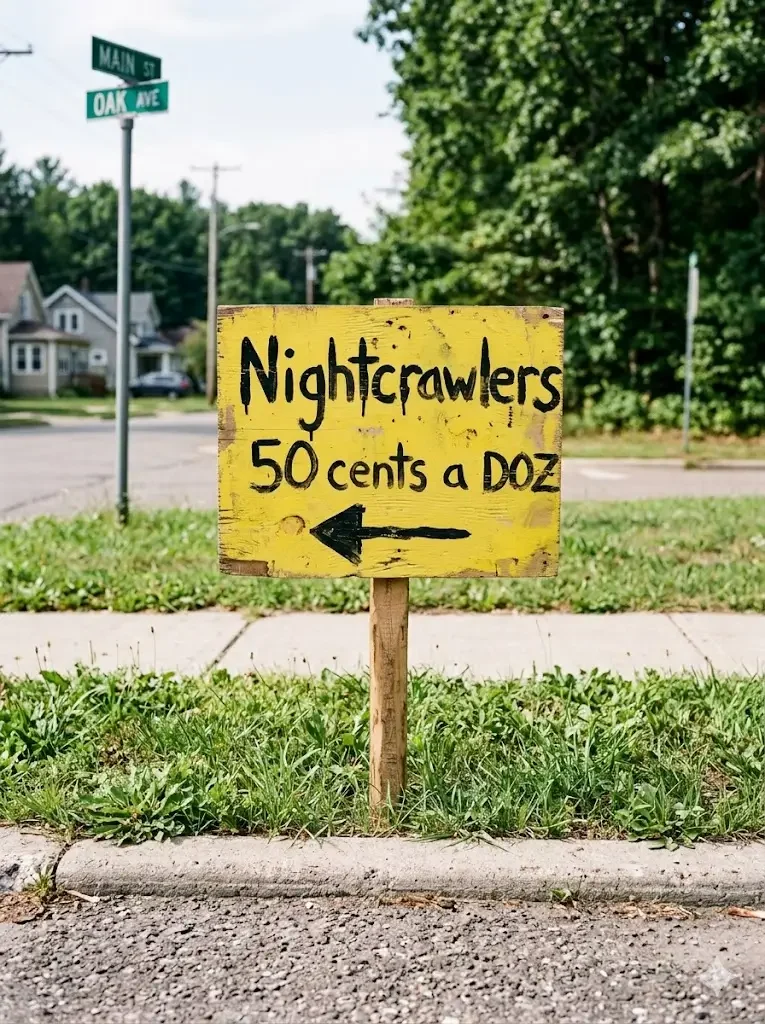
Around 1978, at eight years old, Stephen started his first business out of his family’s garage. He called it Stevie’s Bait Shop. He made yellow signs with black writing, “Nightcrawlers, 50¢ a Dozen” with an arrow pointing to the garage, set up a lawn chair out front, and sold worms directly to the fishermen.
His supply came from the golf course, a half-mile from his house. The course watered every night and brought worms up by the thousands. Stephen got caught sneaking onto the grounds twice. The second time, the groundskeeper looked at him, looked at the bucket, and said, “Just shut the gate when you leave, kid.” So he did.
The business worked immediately. He sold thousands of worms. He undercut the bait shop by half and kept every customer they lost. When other kids and eventually adults copied his signs, Stephen held his price at fifty cents and kept his customers anyway. The bait shop charged more. He charged less. The fishermen knew who to call.
Then he started making his own sinkers. He would ride his bicycle miles to the local gun range, collect hunks of lead out of the sand traps in milk jugs, haul them home, melt them down with his dad, and pour them into molds he bought from the same bait shop he was competing against. From there, he moved to drift-fishing rigs. The rigs were hooks, lines, beads, clevises, spoons, and swivels built from scratch and sold at 50% below the competition. The fishermen would ask him, “What color are they biting on, Stevie?” He always told them, because he paid attention to what worked. That was why they kept coming back.
He ran that business from age eight into high school. It funded his bicycle, art supplies, every musical instrument he ever owned, and his first car. At 50 cents a dozen, the money added up. With a minimum wage of under $3.00 an hour at the time, he was making a lot of cash for a young boy.
In parallel, he ran a year-round bottle-and-can collection business, scouting high-traffic locations and bringing in hundreds of bottles and cans per week. Michigan had a 10-cent deposit on cans and bottles. The youngest of four kids, a family of six living in an 805 sq ft house. Two businesses. One kid. No family money.
“I wasn’t a good student, and I was bullied badly every day. But when someone bought worms from me, they treated me with respect. They valued what I was offering them. That was the first time in my life I felt like I was worth something.”
— Stephen W. Rockwell
He was not thinking about business strategy. He was just solving an obvious problem: the middleman was charging too much, and he could do it cheaper by going direct. Three lessons got locked in early, and they have never left him. Cut out the middleman, go direct to the customer, and understand your own cost structure well enough to serve the customers.
The Artist Who Walked Out of College
Stephen was an artist from the start, and won several art competitions he entered in school. He picked up the guitar at age eight, self-taught, and quickly excelled. As a high school senior, his portfolio was selected for a national tour as part of the National Scholastic Art Awards. He won an art scholarship to junior college. A childhood friend from the same local art scene went on to become a Disney animator, credited on The Lion King, Mulan, and Lilo & Stitch.
Stephen made it through half of the first semester of college, and things took a turn.
Two things broke the deal. The academic side was brutal for a kid with undiagnosed hearing loss who had never been taught how to study. And in his art classes, he realized that making a living as an artist meant producing the art that other people wanted, on their timeline, for their purposes. To Stephen, that was not art. It was a perversion of it.
One day, in the middle of class, he rolled up his work, put it under his arm, quietly walked out, and never came back.
The portfolio that had won him the national scholarship was never returned. It was stolen from the exhibit.
“I would rather build something of my own from nothing than make someone else’s vision for a paycheck. That was true then. It is still true now.”
— Stephen W. Rockwell
A Rainbow Light on QVC (1990–1992)
Right out of high school, Stephen launched two businesses at once: AutoGraphics, a vinyl cutting and sign-making company serving fleet vehicles, and Magellan Promotional Marketing, a freelance commercial art studio. He was producing signage, brochures, and packaging for paying clients while most of his classmates were still figuring out their majors or partying at the boardwalk.
Between 1990 and 1992, Stephen landed a subcontractor contract with PGT Personal Growth Technology. PGT sold corporate wellness programs to Fortune 500 companies: smoking cessation, weight loss, and stress reduction programs built on an audio technology called Visual Sound, developed by a sister company. The programs themselves were written and produced by a Harvard professor named Barry Beiter. The audio recordings were so immersive they were intended to make listeners feel what they heard, decades before “immersive audio” became a buzzword.
Stephen’s role was product design, packaging, brochures, signage, and the visual identity of program materials for Fortune 500 workplaces.
And then there was the Rainbow Light.
The CEO of PGT was an inventor. One of his creations was a children’s therapeutic nightlight called the Rainbow Light, a device that used crystal prisms and specialty optics to cast a true rainbow into a dark room. The product was beautiful, intended for therapeutic use with children, and had been marketed for years without traction.
Stephen saw it, thought about it, and said: “This belongs on QVC.”
He built the promotional materials himself. He drove from Michigan to Pennsylvania with a friend. When he arrived, he needed to clean up for the pitch, so he pulled into a hospital parking lot, walked inside, bathed in a restroom sink, and changed into borrowed business clothes. When he arrived at QVC’s vendor day, he was the youngest person in the room by twenty years. Every other vendor carried fancy metal flight cases and tripods. Stephen had a leather folder and a cardboard box with one Rainbow Light in it. People looked at him like he did not belong, bringing back feelings of his school days.
Sitting there for hours, he watched people go back and then come out, heads hung low, looking defeated. He pitched. QVC signed the agreement. Stephen walked out with his head held high, smiling ear to ear, cardboard box in hand. He still remembers the expressions on the people in the waiting room as they stared at him and his smile. The Rainbow Light aired. He watched it on live television with his parents. It sold.
That day in Pennsylvania is the day Stephen learned that preparation matters less than conviction, and that a cardboard box with the right product inside beats a flight case with the wrong one every time.
The Mentors — Joe and Tony (1990–1998)
In 1990, Stephen rented his first place from a landlord named Joe. Joe owned multiple rental properties and began teaching Stephen real estate as a side conversation while he was his tenant. Joe helped Stephen fund his first business ventures. Joe’s mentor, in turn, was a man named Tony, one of the largest real estate investors in the Tri-County area of Michigan.
Tony was operating at a level Stephen had never seen. He owned hundreds of rental properties, ran his own property management company out of a multi-story office building with a full staff, and operated adjacent service companies that covered construction, roofing, HVAC, siding, and concrete. He was also a real estate developer building new subdivisions.
Between 1990 and 1998, Stephen spent time learning from both men. The real estate bug was planted. The example Tony set of what a single operator could actually build if he understood development, rentals, construction, and management simultaneously stayed with Stephen and eventually drove him to build his own 254-home subdivision in Arizona two decades later.
The Skydive That Changed Everything (1992)
In 1992, at age twenty-two, Stephen and a group of friends decided, on a weekend whim, to go skydiving. They took a three-hour class. The first jump was a solo static line, the parachute pulled automatically by a cord attached to the plane.
As the plane taxied down the runway, he started laughing uncontrollably. A fellow jumper asked him what was so funny. Stephen said: “I’ve never been in a plane before, and I’m about to jump out of it!”
He was one of the last to jump. When his turn came, he sat on the edge of the plane, put his feet on the platform, shimmied out onto the strut, and let go when the jumpmaster said go.
His lines wrapped around the canopy. He began spinning, first in large circles, then in tight ones. The red-and-white lines tangled above him looked like a barber pole. He was falling fast. He kicked and pulled at the cords. The ground came up at him. He closed his eyes and said two words: God, no.
The chute deployed at the last possible moment. He hit the ground running, slid a long distance on his stomach, and looked up to see dozens of people sprinting from the clubhouse toward him. He was alive, no broken bones, alive.
A few weeks later, a 20-year-old jumper died at the same drop zone.
That was the moment Stephen understood, in his bones, that time is finite and that he had been spared for a reason. It was not a conclusion he argued his way into. It was a certainty he walked away from the jump with.
“I believe my life was spared for a reason. That is why I do things the way I do, and built this business the way I did, and it’s how I do everything. Not for fortune. It’s about following my heart, doing what feels right.”
— Stephen W. Rockwell
Car Stuff & Truck Things, and the Second Sign (1992–1998)
From 1992 to 1998, Stephen built Car Stuff and Truck Things, a one-stop wholesale and retail operation serving Michigan auto dealerships and the public with sunroofs, window tinting, and car and truck accessories. The business grew rapidly and employed more than a dozen men, mostly twice Stephen’s age.
Every sunroof installation produced the same byproduct: a rectangular piece of scrap metal cut from the car’s roof. Stephen noticed the scrap was almost exactly the size of the yellow-and-black roadside signs he had used as a kid to sell worms.
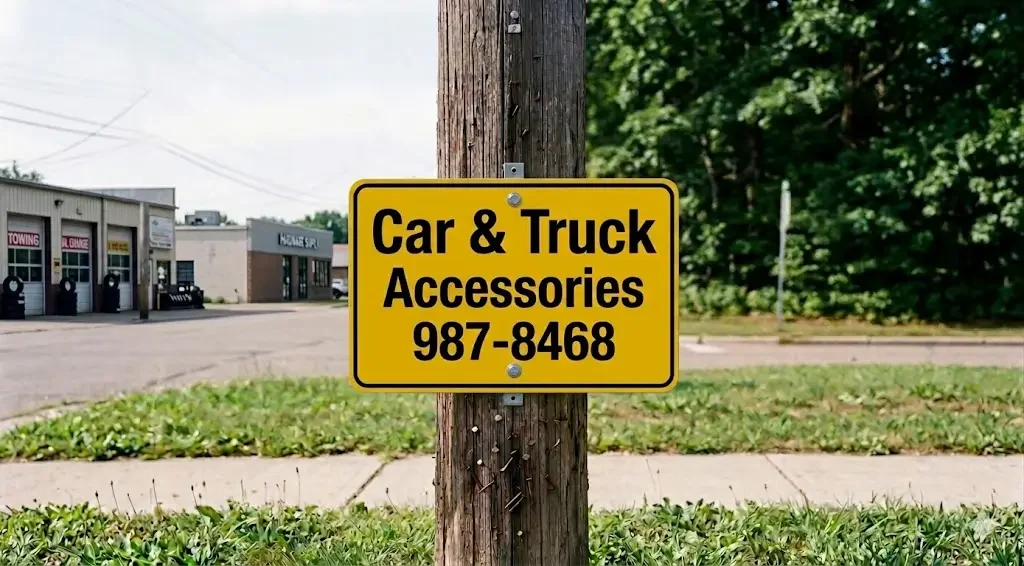
Using the same sign-making equipment he had already been running through AutoGraphics, he turned sunroof scrap into signs reading “Car & Truck Accessories” with his phone number. He posted them heavily throughout the area. They worked immediately.
That was the second time in his life that the sign model proved itself. He did not know yet that the third time would change everything.
Stephen sold Car Stuff and Truck Things for a substantial sum and, with the money he had saved over the years, decided to head West to try his luck.
1999 — We Buy Houses Arizona Is Born
In 1998, Stephen was preparing to move into real estate full-time. The capital was in place from the sale of Car Stuff & Truck Things. His real estate education from Joe and Tony gave him a working frame. Then, on a trip to Florida, he saw them: yellow signs with black writing along the roadside that read WE BUY HOUSES.
The connection hit him immediately — the same sign model he had used for worms, the same sign model he had used for car accessories, only this time the product was houses. He could not get it out of his head.
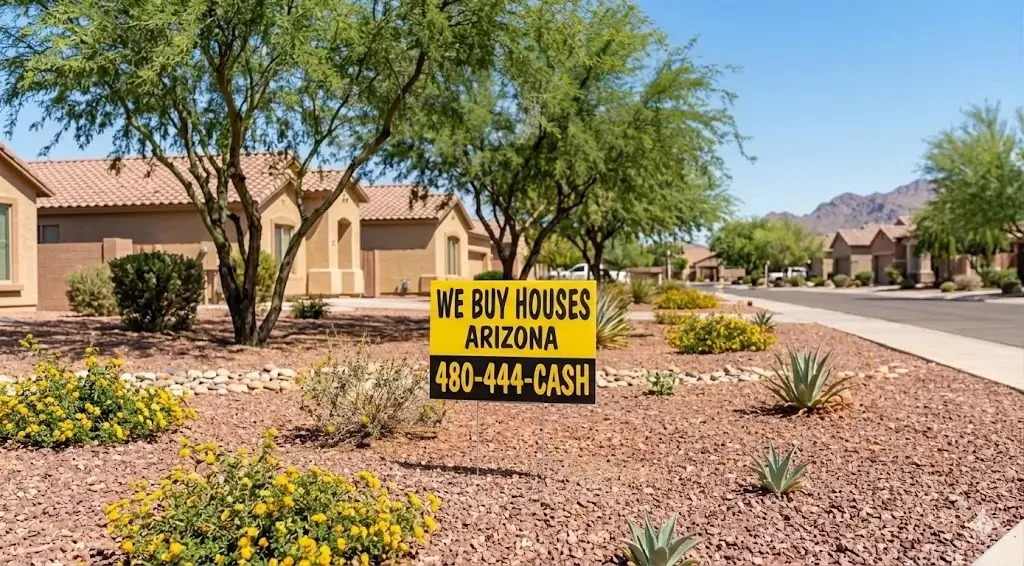
In 1999, Stephen moved to Arizona with a plan: research how to buy houses directly, print signs, and get started. He chose the name We Buy Houses Arizona because it was exact to what he was doing, in the state he was doing it in. It was specific, and it sounded like a real business. The Florida signs said only “We Buy Houses.” He would add his state, and a business was born.
The first batch of signs went up in and around Mesa. The calls started coming in almost immediately.
The First Arizona Home — January 1999
In January 1999, Stephen closed on his first Arizona house. A distressed property in Mesa. The seller was relocating out of state. Stephen bought the house because of the We Buy Houses Arizona sign. He sold the property to a landlord rather than renting it himself. Several more purchases followed that same year. Nearly all of them came from the signs. Stephen’s sign, reading “We Buy Houses Arizona,” later joined by the phone number 480-444-CASH, was the start of a business that would carry him into more than two decades in real estate.
The model had proved itself a third time.
What Ron LeGrand Taught Him (2000)
In 2000, Stephen was personally introduced to Ron LeGrand, one of the most recognized names in American real estate investing, by a mutual friend. That introduction led to direct time with Ron, who taught Stephen the finer points of ethics, deal structure, and assignment strategy during Ron’s visits to Arizona.
What Stephen took from Ron was not the wholesale model most of Ron’s students adopted. He took the discipline. He learned to use contract assignment selectively, not as a revenue stream, but as a way to help trusted investor friends get to good properties at fair prices. Stephen’s own direct buying never stopped. He continued putting his own capital into houses. He simply added a second lane alongside it, where and when a deal fit another investor better than it fit him, he could pass it through cleanly.
Twenty-six years later, both lanes are still running.
Becoming the Problem-Solver (2001–2003)
Around 2001, Stephen noticed that Arizona had a growing class of homeowners who could not sell their homes traditionally because their mortgage debt exceeded the home’s value. He took a formal class on short sales and then taught himself the rest. Over the years that followed, he personally completed several hundred short sales, negotiating directly with banks and loss-mitigation departments. He was doing this years before the 2008 crash made “short sale” a household phrase.
Working that closely with banks led to the next skill. Around 2003, Stephen learned to purchase mortgages directly and structure purchases that combined note and property acquisition, creating solutions where none had existed for home sellers.
And he learned how to negotiate municipal liens, HOA liens, judgment liens, every species of encumbrance that made properties hard to sell or unsellable. He built relationships with lienholders, negotiated payoffs, and unlocked sales no conventional buyer could have completed.
By 2003, Stephen was running four parallel operations: direct cash buying through the signs, selective assignment to trusted flippers, short sales with banks, and complex purchase structures involving mortgages and liens. He formally incorporated HDRE Inc. that same year as the transactional entity for closings. The brand We Buy Houses Arizona remained the public-facing name, and HDRE Inc. continues to operate.
Teaching and Broadcasting (2003)
Around 2003, Stephen became a key member of the Arizona Prosperity Investment Group (AZ PIG), an Arizona real estate investor association founded by the same associate who had introduced him to Ron LeGrand. Stephen regularly taught several hundred members each month about Arizona real estate acquisition, the mechanics of direct buying, and the problem-solving strategies he had developed. AZ PIG is no longer active, but the education he delivered there is.
During the same period, Stephen co-hosted a local radio program called The Sold House, a parody of the title “This Old House” alongside the founder of AZ PIG. The show aired around 2003, and Stephen co-hosted, answering live on-air questions from Arizona homeowners.
Meeting Kerri (2008)
In 2008, Stephen met his wife, Kerri.
He had not been looking. For years, he had been so committed to the business that a relationship was the last thing on his mind. The work of buying distressed homes, working daily with people in foreclosure, divorce, and grief, had made him skeptical of marriage. He had watched too many good people come apart. He had told friends he would never marry.
His friends pushed him to start dating anyway. He was always the third wheel at their dinners. He decided to listen to his friends and put himself out there.
The first night he saw Kerri walk through the door, he said something quietly to himself that he still remembers perfectly, nearly twenty years later: There you are.
It was the same feeling he had watched between his own parents growing up, the same unmistakable recognition. He called his best friend the next day and said, I think I just met my wife. Eighteen years later, over dinner last week, that best friend still remembers and talked about the call.
Kerri had a one-year-old son when they met. Stephen became a stepfather at the same moment he found the love of his life. That chapter is not entirely his story to tell, and parts of it ended with tragic grief he still carries, but what matters for who Stephen is today is this: he learned he could love and be loved.
For the last several years, Kerri has been actively involved in the day-to-day operations of We Buy Houses Arizona. People who know them call them a power couple. Stephen makes the final decisions, and Kerri serves as the sounding board and sometimes the voice of reason. She is the one who keeps him grounded when the work gets hard, and she has been through the good, the bad, and the ugly of it with him.
“The best thing that ever happened to me in my life was meeting my wife. Nothing I have built means anything without her.”
— Stephen W. Rockwell
Auctions, webuyhousesarizona.com, and the LLC (2012–2019)
Starting around 2012, Stephen added another lane: personal bidding at Arizona’s property auctions. The process required running financial analysis on hundreds of properties per week, driving to the courthouse, and bidding in person with cash in hand. He still purchases from auctions selectively today. The experience has generated a deep body of property valuation knowledge that reinforces everything else the business does.
In August 2017, Stephen launched the current webuyhousesarizona.com on the Carrot platform and moved the business to a fully online model. Stephen owned the domain since 2004, and the world hadn’t fully moved toward online yet. He had another brand he tried online first in 2005, nicehomebuyer.com, and forwarded the We Buy Houses Arizona domain to it. It was a test, but it didn’t get traction, and the signs were still working. As time went on, sellers were researching more online before they called. The website became the new storefront. The yellow bandit signs, which had carried the business for 18 years, were retired as the primary marketing channel.
In February 2019, the formal We Buy Houses Arizona LLC was registered in Arizona. The same year, the company earned Better Business Bureau accreditation, a rating it has maintained at A+ ever since.
San Tan Valley — A 254-Home Subdivision (2014–2022)
In 2014, Stephen purchased raw land in San Tan Valley, Arizona, and set out to do what Tony had inspired him to do two decades earlier in Michigan: develop a subdivision from the ground up.
He purchased the land with creative financing and cash. He assembled the team of developers, civil engineers, and entitlement specialists and drove the project through entitlement and into a fully platted, development-ready state. In March 2022, he closed the sale of the completed 254-lot subdivision to Mattamy Homes, one of North America’s largest private homebuilders.
The project ran for eight years. Throughout it all, he continued buying individual houses through We Buy Houses Arizona, kept using the signs through 2017, launched the website, and continued operating every other line of the business simultaneously.
“Money, especially big money, makes people betray the man with the vision and the real opportunity maker. Protecting yourself from wolves in business is essential. In the 11th hour, men’s true character will surface. Like a tiger in a circus, they will turn and bite you. It’s in their nature.”
— Stephen W. Rockwell
Auctions, webuyhousesarizona.com, and the LLC (2012–2019)
One of Arizona’s Top Investor Websites by Carrot (2023)
In 2023, the founder, Trevor Mauch, CEO of Carrot, the largest real estate investor website platform in the United States, and an Inc. 5000 fastest-growing company, personally invited Stephen to attend a Carrot company retreat. Stephen thought he was going to socialize with the team. When he arrived, he was led onto the stage: he had one of the top real estate investor websites in Phoenix, Arizona, on the Carrot platform, and the CEO had brought him in as a featured speaker. Stephen spoke, unprepared, about Michigan, the signs, the Arizona launch, the decision to move the business online, and the trials that came with it. The talk got emotional. Trevor and Stephen have remained in contact since, and the two had lunch together in Arizona earlier this month.
The Self Made Man — A Personal Story in Stephen’s Own Words
A personal story, if you’d like to know Stephen. Told in his own words.
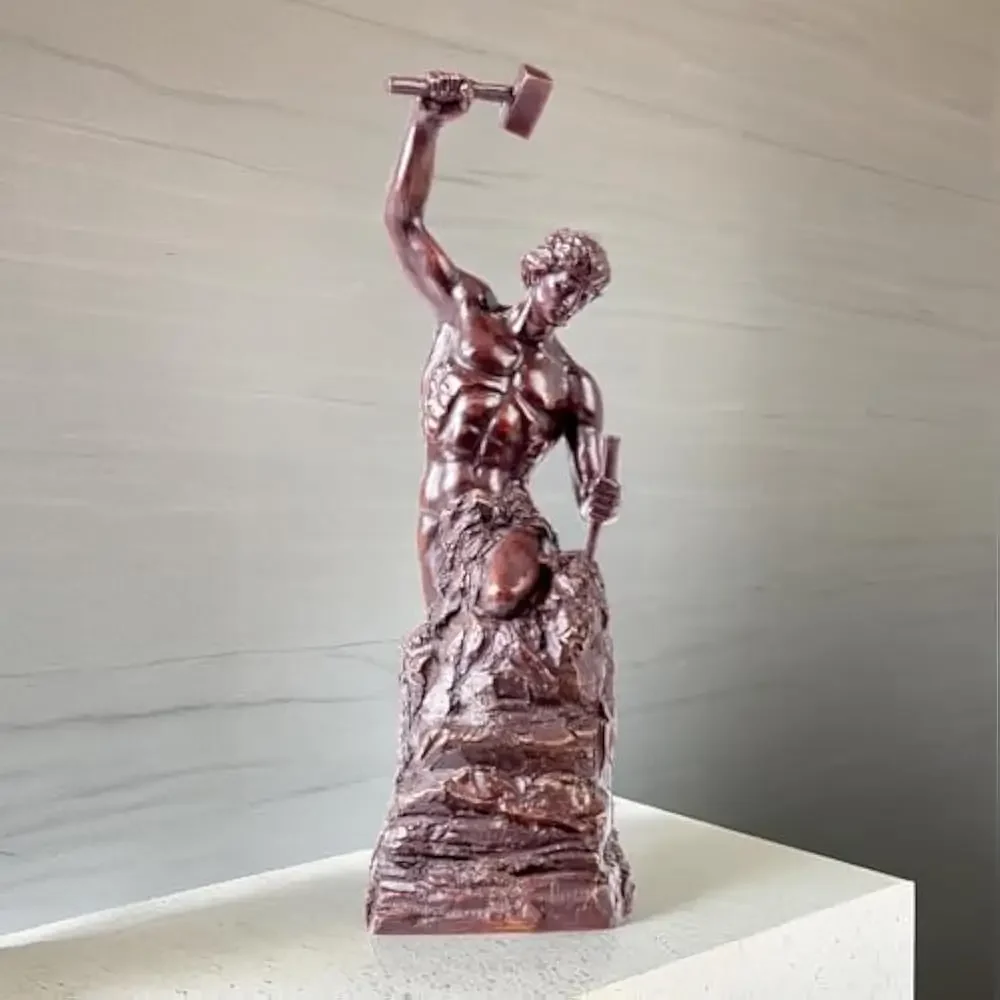
In 1999, my brother Bob and I took a trip to Sedona, Arizona. We were walking around the cute shops, restaurants, and art galleries when I first encountered my lifelong obsession. As an artist, I consider art galleries among my favorite places in the world. While walking through one gallery, I noticed a statue, and something stopped me cold.
It was a spiritual moment. My eyes locked onto that statue, and I followed every line, every curve. I felt the artist’s emotion, the passion carved into the statue, the vision made real. I couldn’t stop thinking about it. It meant something. I just didn’t know what.
But it stayed with me. The Self Made Man followed me for decades. I put a picture on my phone that served as my screensaver for years. It became my desktop background on my computer. The obsession grew. Over the years, it simply meant something to me, something I couldn’t quite name, but something I couldn’t ignore.
After years of staring at that image, I made a conscious decision: someday, somehow, someway, I would have my own Self Made Man. I told only a few people in my life what it meant to me and how it made me feel. When I met my wife in 2008, I shared the picture with her. I told her what it meant. I told her having it would be my destiny.
Then came October 2, 2022.
My wife, our friends Shannon and Lonie (Lonie, who works with me on my team), and I took a trip to Jerome. We decided to go hiking in Sedona. As we were driving through Sedona, I looked out the window and spotted a statue. My eyes couldn’t believe what I was looking at. It was a thirteen-foot-tall Self Made Man, standing right there alongside the road.
I screamed. “Stop! Stop! Go back! We need to go back!”
We parked the car. I was in shock. Standing in front of a larger-than-life statue of this beautiful obsession from my life, this thing I’d carried for over twenty years, I couldn’t believe what I was looking at. It wasn’t a picture on a screen anymore. It was real, and over ten feet taller than the one from the art gallery in 1999.
I climbed up on the statue. I held the chisel that the Self Made Man was carving himself with. I raised my hand like a hammer. In that moment, I was connected, finally connected, to what the Self Made Man truly meant.
Because it’s not about money. People tend to think “self made” means wealth, status, pulling yourself up by your bootstraps, and getting rich. But that’s not it at all. It’s about following your passion and becoming the best version of yourself. It’s about the work. The chisel and the hammer. Carving yourself out of the stone, bit by bit, refusing to wait for permission, refusing to settle. Creating yourself with your own hands, your own effort, your own vision. That’s what the Self Made Man is.
I climbed back down and got in the car with my wife, Lonie, and Shannon. I was quiet at first, processing what had just happened. Then I began thanking everyone repeatedly. They had stopped. They had turned around. They had let me have that moment. It was a quick detour, but it meant the world to me.
What I didn’t know was happening behind the scenes.
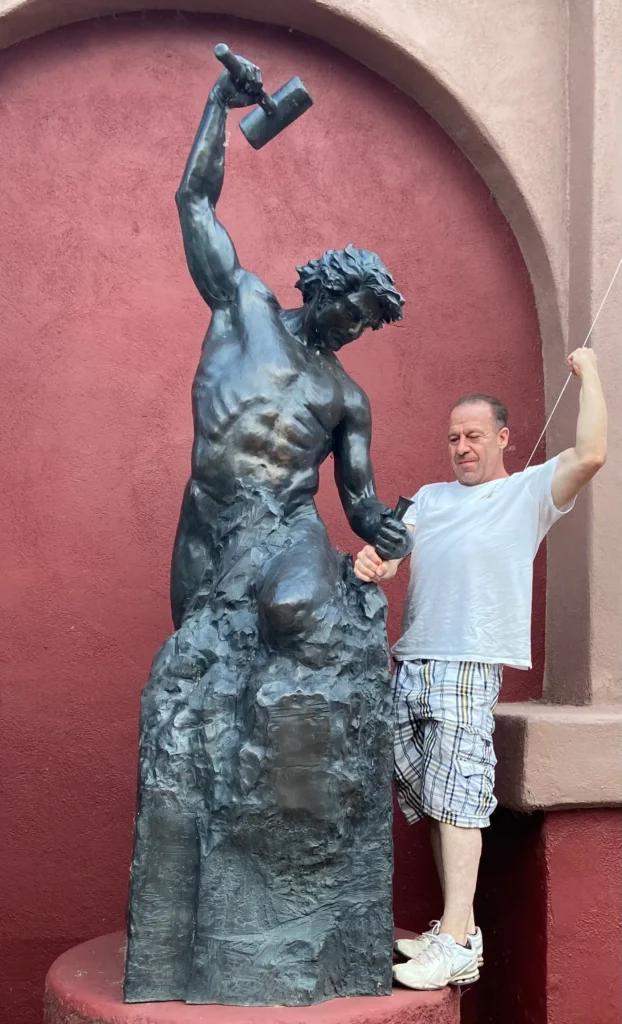
On October 2, when I climbed that thirteen-foot statue, my wife had already tracked down the artist. She had contacted her directly. She had purchased something from the artist and had it sent to her. She was waiting for our anniversary. The visit to the Self Made Man statue was not planned, totally organic — I call it divine intervention, not coincidence.
October 7 was our tenth wedding anniversary.
That morning, I was drinking my morning coffee when my wife placed a large box on the coffee table in front of me. “I got you something, husband,” she said. “I hope you like it.”
I tried to pick up the box, but it was extremely heavy. I had to stand up.
Inside was a statue of the Self Made Man, the same one I had seen in that gallery in 1999. The one that had stopped my soul twenty-three years ago. The one I had carried on my phone, on my desktop, in my heart. My wife had found it. She had understood what it meant. She had made my destiny real.
But there was more. Inside the box was a note from the artist herself.
It read: “Steven, I hope you enjoy your own Self Made Man. Give him a good home for many more years to come. — Bobbie Carlyle”
The artist knew my name. She understood what she was giving me, not just a statue, but my Self Made Man. The one who called to me across two decades. And she was blessing it, asking me to give him a good home.
Now, every single day when I enter my office and climb to the top of the stairs, the very first thing I see is my Self Made Man standing in front of me. He’s my daily reminder. Not about money or status or external success. He’s my mirror. He reminds me that I’m still doing the work. Still carving. Still becoming the best version of myself. Still following the passion that called to me in that gallery in 1999.
That’s what the Self Made Man means. That’s what my wife understood when she made my destiny real on our tenth anniversary. That’s what I see every morning when I climb those stairs.
The chisel. The hammer. The work. The becoming.
That’s the Self Made Man.
The Self Made Man — A Personal Story in Stephen’s Own Words
A personal story, if you’d like to know Stephen. Told in his own words.
In 1999, my brother Bob and I took a trip to Sedona, Arizona. We were walking around the cute shops, restaurants, and art galleries when I first encountered my lifelong obsession. As an artist, I consider art galleries among my favorite places in the world. While walking through one gallery, I noticed a statue, and something stopped me cold.
It was a spiritual moment. My eyes locked onto that statue, and I followed every line, every curve. I felt the artist’s emotion, the passion carved into the statue, the vision made real. I couldn’t stop thinking about it. It meant something. I just didn’t know what.
But it stayed with me. The Self Made Man followed me for decades. I put a picture on my phone that served as my screensaver for years. It became my desktop background on my computer. The obsession grew. Over the years, it simply meant something to me, something I couldn’t quite name, but something I couldn’t ignore.
After years of staring at that image, I made a conscious decision: someday, somehow, someway, I would have my own Self Made Man. I told only a few people in my life what it meant to me and how it made me feel. When I met my wife in 2008, I shared the picture with her. I told her what it meant. I told her having it would be my destiny.
Then came October 2, 2022.
My wife, our friends Shannon and Lonie (Lonie, who works with me on my team), and I took a trip to Jerome. We decided to go hiking in Sedona. As we were driving through Sedona, I looked out the window and spotted a statue. My eyes couldn’t believe what I was looking at. It was a thirteen-foot-tall Self Made Man, standing right there alongside the road.
I screamed. “Stop! Stop! Go back! We need to go back!”
We parked the car. I was in shock. Standing in front of a larger-than-life statue of this beautiful obsession from my life, this thing I’d carried for over twenty years, I couldn’t believe what I was looking at. It wasn’t a picture on a screen anymore. It was real, and over ten feet taller than the one from the art gallery in 1999.
I climbed up on the statue. I held the chisel that the Self Made Man was carving himself with. I raised my hand like a hammer. In that moment, I was connected, finally connected, to what the Self Made Man truly meant.
Because it’s not about money. People tend to think “self made” means wealth, status, pulling yourself up by your bootstraps, and getting rich. But that’s not it at all. It’s about following your passion and becoming the best version of yourself. It’s about the work. The chisel and the hammer. Carving yourself out of the stone, bit by bit, refusing to wait for permission, refusing to settle. Creating yourself with your own hands, your own effort, your own vision. That’s what the Self Made Man is.
I climbed back down and got in the car with my wife, Lonie, and Shannon. I was quiet at first, processing what had just happened. Then I began thanking everyone repeatedly. They had stopped. They had turned around. They had let me have that moment. It was a quick detour, but it meant the world to me.
What I didn’t know was happening behind the scenes.
On October 2, when I climbed that thirteen-foot statue, my wife had already tracked down the artist. She had contacted her directly. She had purchased something from the artist and had it sent to her. She was waiting for our anniversary. The visit to the Self Made Man statue was not planned, totally organic — I call it divine intervention, not coincidence.
October 7 was our tenth wedding anniversary.
That morning, I was drinking my morning coffee when my wife placed a large box on the coffee table in front of me. “I got you something, husband,” she said. “I hope you like it.”
I tried to pick up the box, but it was extremely heavy. I had to stand up.
Inside was a statue of the Self Made Man, the same one I had seen in that gallery in 1999. The one that had stopped my soul twenty-three years ago. The one I had carried on my phone, on my desktop, in my heart. My wife had found it. She had understood what it meant. She had made my destiny real.
But there was more. Inside the box was a note from the artist herself.
It read: “Steven, I hope you enjoy your own Self Made Man. Give him a good home for many more years to come. — Bobbie Carlyle”
The artist knew my name. She understood what she was giving me, not just a statue, but my Self Made Man. The one who called to me across two decades. And she was blessing it, asking me to give him a good home.
Now, every single day when I enter my office and climb to the top of the stairs, the very first thing I see is my Self Made Man standing in front of me. He’s my daily reminder. Not about money or status or external success. He’s my mirror. He reminds me that I’m still doing the work. Still carving. Still becoming the best version of myself. Still following the passion that called to me in that gallery in 1999.
That’s what the Self Made Man means. That’s what my wife understood when she made my destiny real on our tenth anniversary. That’s what I see every morning when I climb those stairs.
The chisel. The hammer. The work. The becoming.
That’s the Self Made Man.
Still Buying Arizona Homes, Still in Mesa
Today, We Buy Houses Arizona is still run by Stephen W. Rockwell, from Mesa, Arizona, under the same brand he has used since 1999, working in the same state he has worked for twenty-seven years. The shirt he wears most days has the company’s name and logo. Kerri gets tired of him in those shirts, but understands who she married.
More than 2,000 Arizona homeowners have sold directly to Stephen. Many of them were in situations no other buyer could solve — a bad mortgage, a lien, a house full of damage, an inherited property with out-of-state heirs, a foreclosure days from auction. The business is built on the same principle the worm shop was built on: serve the customer directly, understand the real problem, price it honestly, and close it cleanly.
Stephen is the founder, the owner, the buyer, the decision-maker, and the face of the brand — then, now, and for whatever time he has left.
“We Buy Houses Arizona is more than my brand. It is an extension of me. It is who I am, or part of who I am. I love my business. I love what I’ve created. Most of all, I love what the business has done for people.”
— Stephen W. Rockwell
Talk to Stephen
If you have a house to sell in Arizona, or just want to know your options, reach out. The same person who started this in 1999 will be the one who answers. No pressure, no obligation.
Content by Stephen W. Rockwell — Founder, We Buy Houses Arizona. Mesa, Arizona. Est. 1999. BBB A+ Accredited. Updated April 2026.